PuriBreeze Produce Cleaner Review: What It Removes, What SFA Already Tests, and the Currency Question
Singapore imports more than 90% of its food. Every consignment is licensed, declared and subject to inspection, and the Singapore Food Agency samples produce both at the border and on the shelf. So the useful question is not whether your vegetables were checked. It is what happens between the check and your wok — and why the checkout charges you in a dollar it does not name.
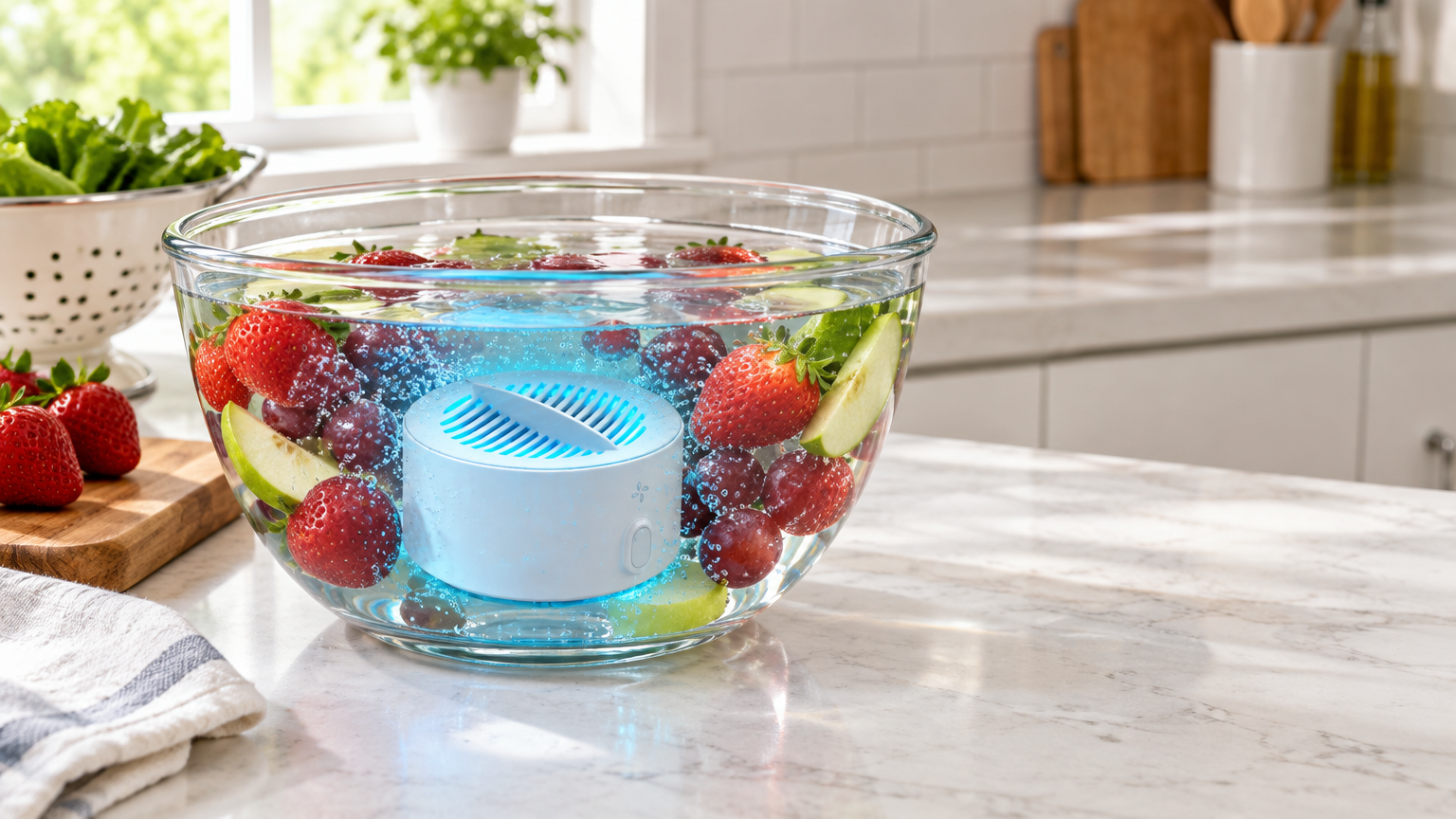
From S$79.99 per unit (4-pack) · Shipping from S$6.95 · 30-day money-back promise (per seller)
The short version
The device does real chemistry. OH-ion electrolysis genuinely generates reactive oxygen species, and the microbubbles do physically lift surface debris. That part is not marketing. What a five-minute kitchen cycle is not, is a validated sanitising process: effectiveness depends on concentration, contact time and the organic load in the water, and no independent laboratory test of this specific model is published.
The honest Singapore framing: SFA licenses the importer, requires a permit for every consignment, and samples produce at the border and in the market. None of that removes the wax film, the handling grit, or the residue sitting on the surface of the bok choy in your chiller. A bowl cycle addresses that layer — the one after the regulator, not instead of them.
Two things to know before you click. The checkout shows dollar figures without stating which dollar, and they match US pricing exactly. And GST at 9% may apply on imported low-value goods depending on how the seller is registered.
Searching for a PuriBreeze review in Singapore usually comes down to three questions: does PuriBreeze work, is it worth the money here, and what is the checkout actually charging? This review answers them using documentary evidence only: the seller's specifications and claims, the prices and currency behaviour observed at checkout, public information from the Singapore Food Agency, Singapore Customs and IRAS, and public literature on electrolysis. No laboratory test of the unit was carried out.
Quick facts
Specifications as listed by the seller, plus the checkout details we observed.
- Technology
- OH-ion electrolysis generating oxygen microbubbles
- Cycle
- About 5 minutes, one button
- Rating
- IPX7, fully submersible
- Power
- Cordless, rechargeable
- Claimed removal
- Up to 99% of pesticides and bacteria (seller's claim, no independent test published)
- Best realistic use
- Wax, grit and surface residue on produce eaten raw
- Not a substitute for
- Cooking, sourcing, or SFA border inspection and market sampling
- Price
- From S$79.99 per unit on the 4-pack; S$99.95 single
- Shipping
- S$6.95 to S$9.90 by pack size, added at payment
- Checkout currency
- Dollar figures shown without a currency label; matches US pricing
The chemistry, honestly
OH-ion electrolysis passes an electric current through water. The process produces hydroxyl radicals and other reactive oxygen species with real oxidising power, alongside microbubbles that physically lift debris from the micro-crevices of a peel or leaf. It is a genuine mechanism, and it is used industrially in food processing and effluent treatment.
What the marketing leaves out is that the effect depends on dose, time and the organic load in the water. A portable unit in a kitchen bowl of tap water does not hold a controlled concentration the way an industrial line does. Singapore's tap water is potable and of good quality, which means you do not need to worry about the water itself, but it also means the device is not working against a contaminated baseline.
What SFA actually does
Singapore imports more than 90% of the food it consumes. That dependency has produced one of the more structured import regimes anywhere: fresh produce can only be brought in by licensed importers, every consignment must be declared and carry a valid import permit, and fresh vegetables may be inspected on arrival.
The rules are specific. Imported fresh fruit and vegetables may not contain prohibited pesticides, and may not carry pesticide or toxic chemical residue above the levels prescribed in the Ninth Schedule of the Food Regulations. SFA publishes a Pesticide Search Tool listing approved agricultural pesticides. Samples of imported and locally grown produce are tested for residues — at the point of import and again in the market. Products that fail are not allowed for sale and enforcement action follows.
And here is the part that most review pages would skip. SFA states plainly that MRLs are not food safety limits: they are set with a large safety margin, so food found above an MRL does not necessarily pose a health risk. That is an unusually candid position for a regulator, and it matters for how you read any scare story about produce.
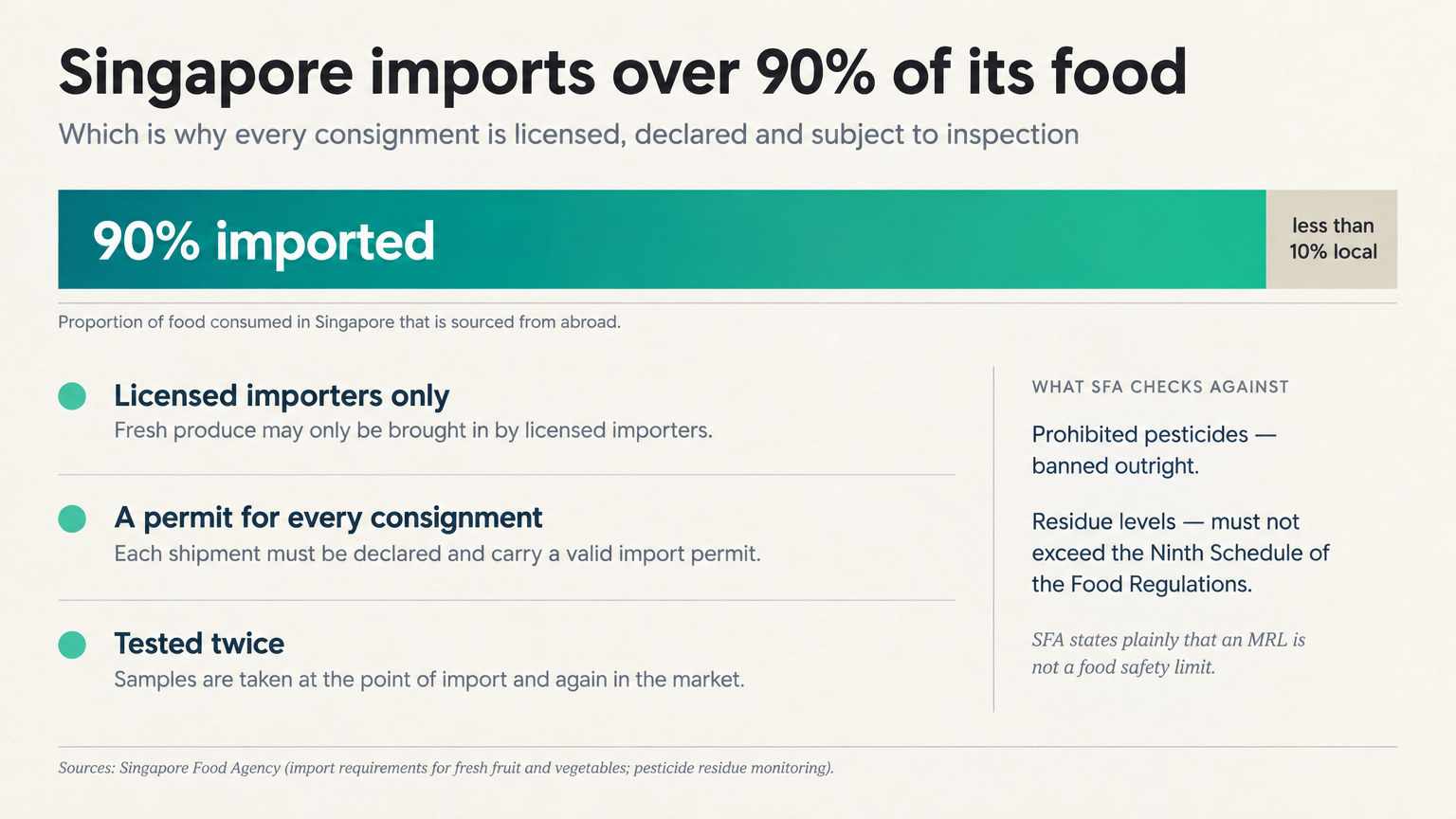
Two things are true at once. The produce in your supermarket has passed a licensing and inspection regime that most countries would envy, and SFA is honest enough to say that an MRL exceedance is not the same as a health risk. And it still arrives with a wax film, handling grit and surface residue that no border inspection removes. A bowl cleaner addresses that second layer. It does not replace the first, and any page that implies otherwise is selling you fear.
The cabbage story, and what it actually means
On 6 October 2026, the Minister for Sustainability and the Environment answered a parliamentary question about the safety of imported cabbage. SFA had stepped up surveillance and testing of cabbage, other vegetables, and related products including kimchi, following reports of alleged formaldehyde use on cabbages from China. The Ministry stated that, so far, there was no evidence to suggest the products imported into Singapore were contaminated with formaldehyde, and that SFA would continue to monitor and conduct further sampling where necessary.
Read that carefully, because it cuts both ways. It is not a scandal — it is a regulator responding publicly and increasing testing. And it is also not something a countertop device addresses: formaldehyde contamination, if present, is a chemical treatment applied before shipment, not a surface film a five-minute rinse lifts off. If your concern is chemical contamination of imported produce, the control that matters is the import and testing regime, and it is already running.
What a 5-minute cycle can and cannot do
What it can do
- Lift visible dirt and grit
- Soften and strip the wax coating applied to apples, capsicum and citrus
- Reduce surface pesticide residue (plausible mechanism, unquantified by any published test)
- Make a rinse more thorough than holding produce under the tap
- Give you a repeatable routine with no measuring
What it cannot do
- Kill pathogens inside tissue
- Guarantee 99% removal of anything (a seller's claim)
- Extend shelf life fivefold (no published basis)
- Replace cooking
- Substitute for SFA licensing, inspection and market sampling
- Remove a chemical treatment applied before shipment
What it actually is
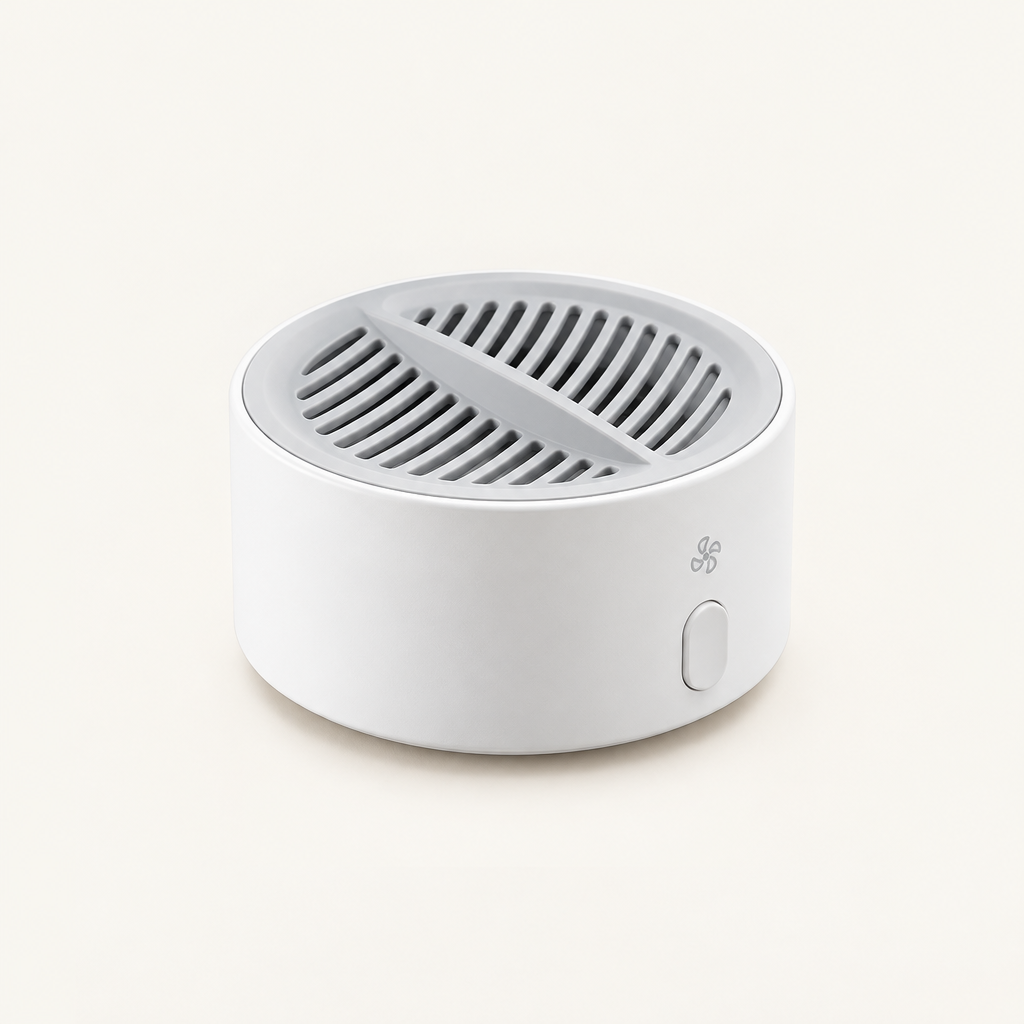
The PuriBreeze is a compact, low-profile puck — matte white, roughly the size of a large doughnut, and about as heavy as a full mug. The whole interface is one oval button on the side, under a small printed fan icon. There is no display, no app, no dial. The top is a circular grey grille divided by a cross bar, and that grille is where the light comes out when it is working. It is rated IPX7 and it runs cordless, so the entire cycle happens with the unit fully underwater.
The five-minute ritual
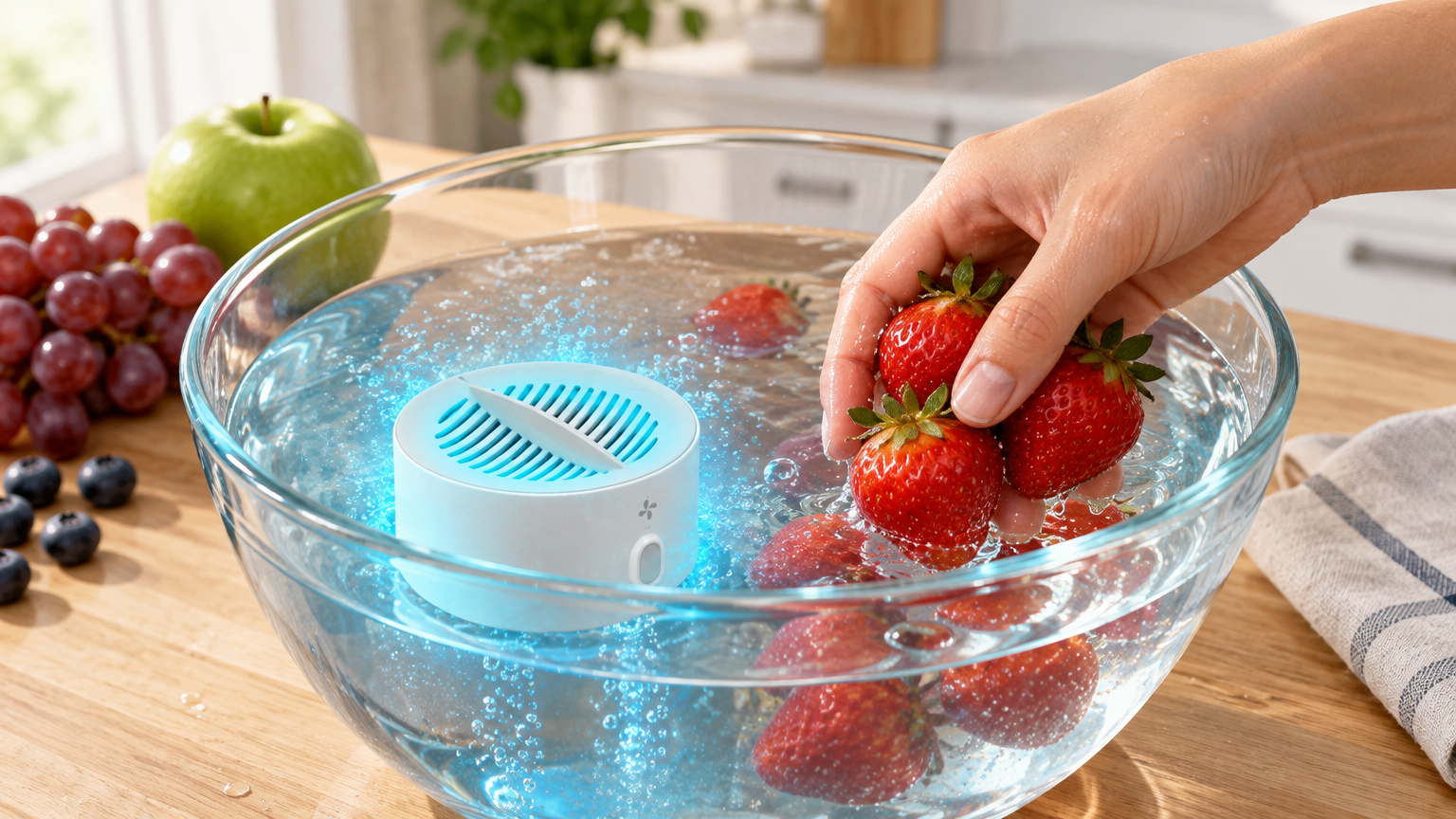
The routine as described in the seller's instructions.
- Fill a bowl with water.
- Add the produce.
- Press the button and wait five minutes.
- Lift, rinse under the tap, and refrigerate.
The real cost per use
A single purchase with no consumables. Per-wash figures are estimates.
| Option | Upfront | Per wash | Over 2 years |
|---|---|---|---|
| PuriBreeze | S$99.95 | ~S$0.02 | ~S$99.95 |
| Produce wash spray | S$0 | ~S$0.35 | ~S$180 |
| Vinegar soak | S$0 | ~S$0.10 | ~S$50 (plus the smell) |
Break-even against a produce spray lands around 30 washes — roughly two months of normal use. Singapore electricity tariffs are low; the marginal cost of a five-minute cycle is negligible.
Prices, currency and GST
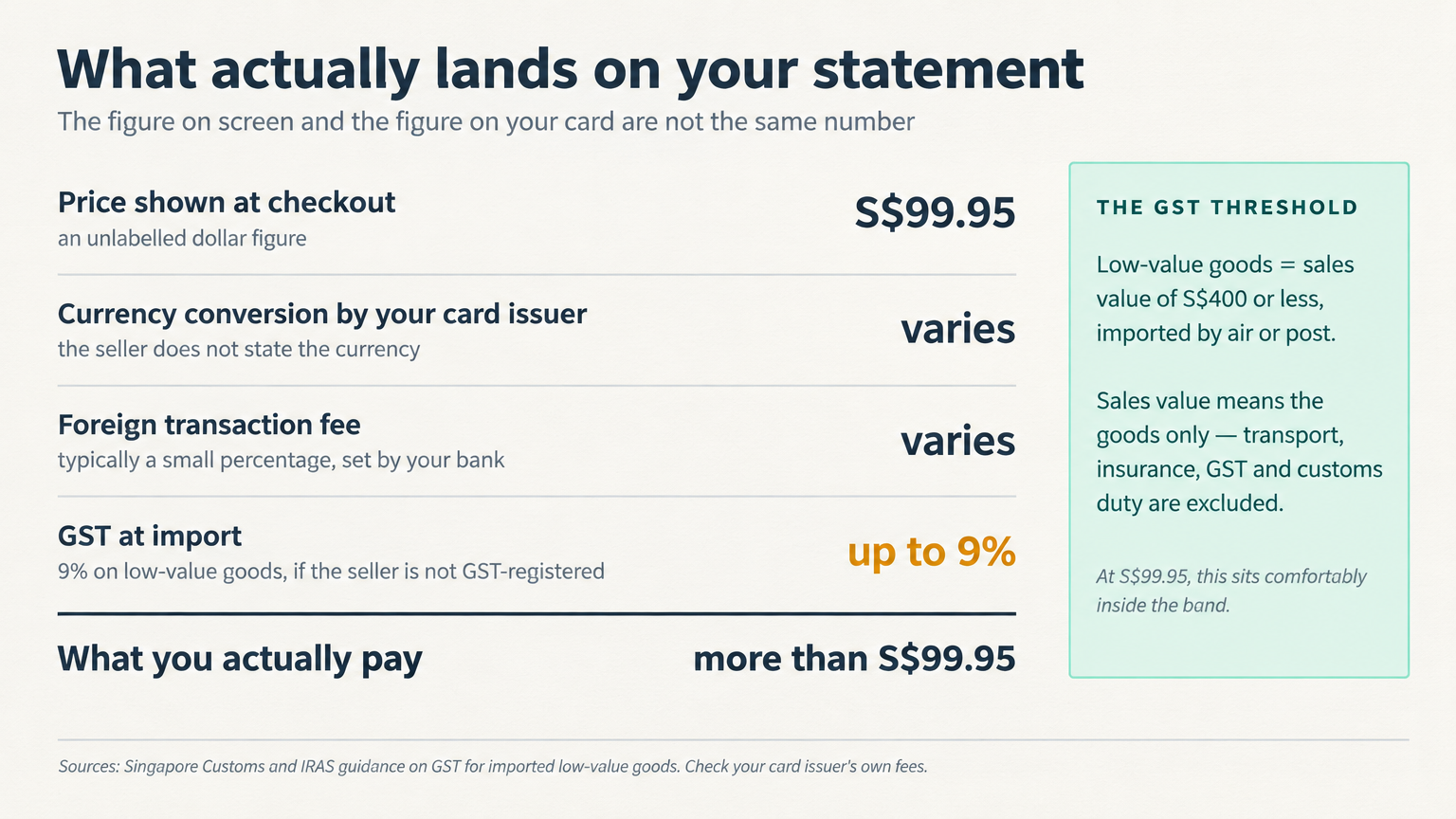
Separately, GST applies to imported low-value goods. Goods with a sales value of S$400 or less, imported by air or post, are in scope. Where the overseas seller is GST-registered, the tax is charged at checkout; where it is not, GST is collected at importation. The rate is 9%. Note how sales value is defined: the price of the goods only — transport, insurance, GST and customs duty are excluded from that threshold. So the S$99.95 unit price falls well inside the low-value band.
The package figures below are what appears at checkout. We have labelled them S$ for readability, but that label is ours, not the seller's — the page itself does not say.
2-pack
3-pack
4-pack
Shipping is added at the payment step — it is not shown on the package-selection screen. One unit is enough for a household of four. Multi-packs only make sense for gifting or a second kitchen.
Safety and the IPX7 claim
IPX7 means the unit is protected against immersion up to one metre for 30 minutes. It is a water-ingress rating, not a certification for contact with food. Use potable water: Singapore's tap water is potable, which settles that point. Discard the water after the cycle and do not leave produce sitting in the bowl afterwards.
Who it's for — and who it isn't
For
- Real electrolysis chemistry
- Cordless and fully submersible
- Five-minute, one-button routine
- Helps with wax and surface grit
- No consumables to rebuy
- IPX7 rating
- Tap water here is potable, so no extra filter needed
Not for
- No independent test published
- "99%" is a seller claim
- Does nothing about pathogens inside tissue
- "5x shelf life" is unsupported
- Checkout currency is not clearly labelled
- Around S$100 is a lot for a rinse aid in a market with strong border controls
Frequently asked questions
Answers based on the seller's claims and the public sources cited above.
What is PuriBreeze?
A cordless, fully submersible produce cleaner that uses OH-ion electrolysis to generate oxygen microbubbles in a bowl of water. It runs a cycle of about five minutes with one button.
How does OH-ion electrolysis work?
An electric current passes through water, producing hydroxyl radicals and other reactive oxygen species along with oxygen microbubbles that can lift debris from surfaces. The process is used industrially, but its effect depends on dose, time and organic load.
Does it remove 99% of pesticides?
99% is the seller's claim. No independent laboratory test of this specific model has been published, so the figure cannot be verified.
Does it kill bacteria like E. coli and Salmonella?
The seller claims it does. Effectiveness depends on concentration, contact time and water load, and no published independent test confirms the claim for this device.
Doesn't SFA already check imported produce?
SFA licenses importers, requires a permit for every consignment, may inspect fresh vegetables on arrival, and samples produce at the border and in the market for pesticide residues against the Ninth Schedule of the Food Regulations. That is a legal compliance regime. It does not remove surface wax or grit from what you bring home.
What about the cabbage and formaldehyde reports in 2026?
On 6 October 2026 the Ministry of Sustainability and the Environment stated that SFA had stepped up surveillance and testing of cabbage and related products following reports of alleged formaldehyde use on cabbages from China, and that so far there was no evidence the products imported into Singapore were contaminated. A countertop rinse would not address a chemical treatment applied before shipment.
What currency does the checkout charge in?
The checkout displays dollar figures without a currency label, and the numbers match the US pricing exactly. Treat it as a US-dollar charge and confirm with your card issuer about foreign transaction fees and exchange rates.
Do I pay GST?
GST applies to imported low-value goods with a sales value of S$400 or less imported by air or post. If the overseas seller is GST-registered, GST is charged at checkout; if not, it is collected at importation. The rate is 9%.
How much is shipping?
S$6.95 for one unit, S$7.90 for the 2-pack, S$8.95 for the 3-pack and S$9.90 for the 4-pack. Shipping is added at the payment step and is not shown on the package-selection screen.
How does the 30-day guarantee work?
According to the seller, you can return the device within 30 days for a money-back refund. Confirm in writing who pays return shipping before ordering, since the return address is overseas.
Verdict
The PuriBreeze is a plausible rinse aid with a real electrochemical mechanism and no independent evidence for the headline claims. Singapore's import system already licenses, declares, tests and samples the produce you buy, and SFA is candid that an MRL is not a safety threshold. What remains is surface wax, grit and handling residue, which a five-minute cycle may improve. Whether that is worth around S$100 — and whether you are comfortable paying in a dollar the checkout never names — is your call.
Pay with Visa, Mastercard, Amex, Discover, PayPal, Apple Pay, Google Pay or Klarna — check your card's foreign transaction fee first