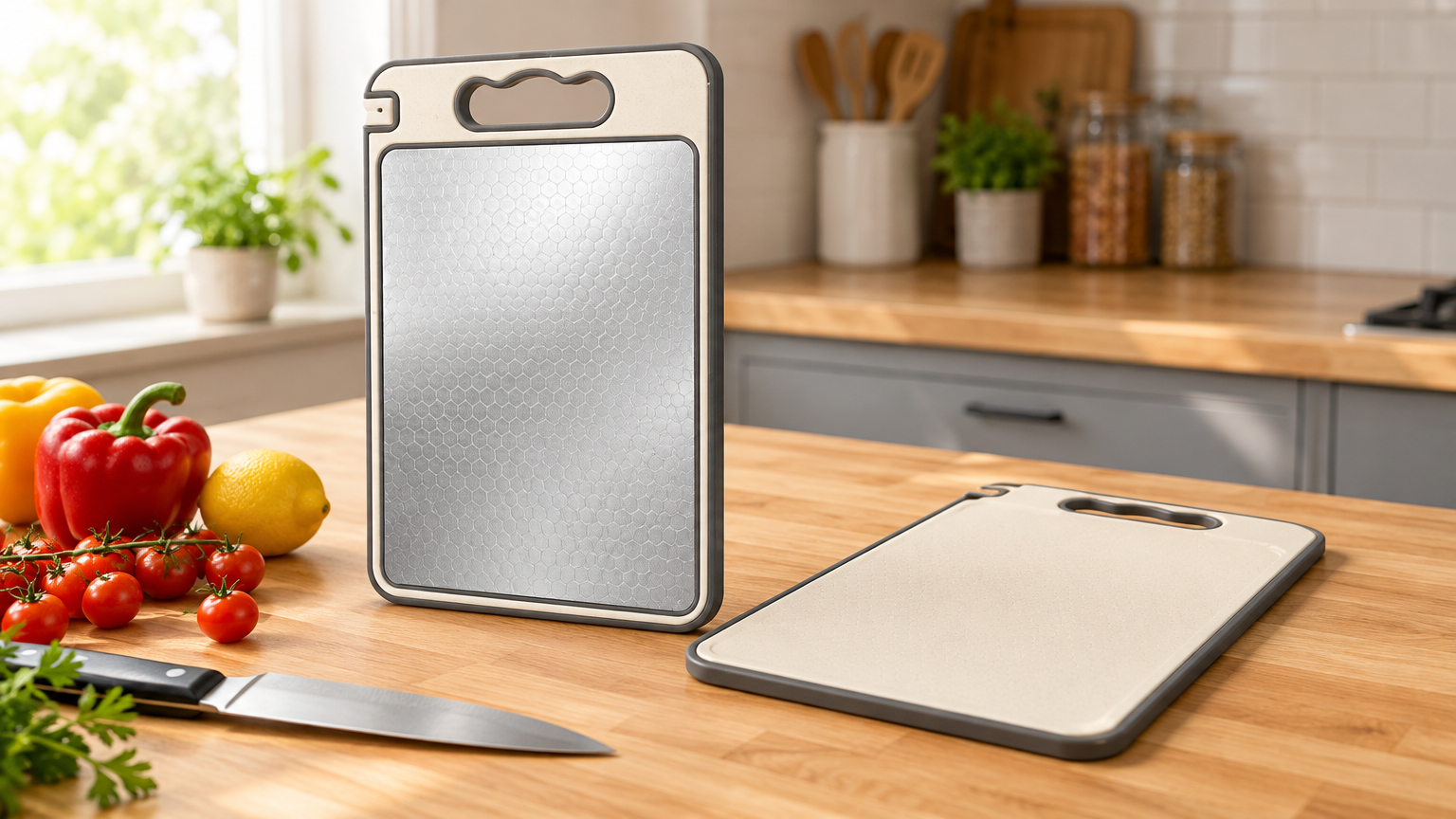
The KensaiChef is a double-sided cutting board built around one idea: keep raw meat and fresh produce on separate surfaces so they never share a board. One face is a sheet of textured titanium, the other is a wheat straw fiber composite, and a charcoal rubber rim keeps it from sliding. It sells direct, at $59.99 for one board and as low as $35.90 per board in a four-pack, plus shipping. This review treats it as what it is: a well-targeted answer to a real kitchen problem, with one limitation the sales page never mentions. That limitation concerns your knives, and it matters enough that we gave it a full section rather than burying it in the fine print.
The Short Answer
Why We Are Reviewing a Cutting Board Material, Not Just a Product
Most cutting board reviews compare boards. That is the wrong comparison, because the board itself is not the problem. The problem is what the board quietly adds to your food, and what it lets cross from one ingredient to the next.
Two risks get talked about constantly and confused with each other: microplastics, which come from the board breaking down, and cross-contamination, which comes from food touching a surface that was not cleaned. The KensaiChef addresses both, but not equally well. Understanding that difference is the entire point of buying it.
What Microplastics Actually Mean on a Cutting Board
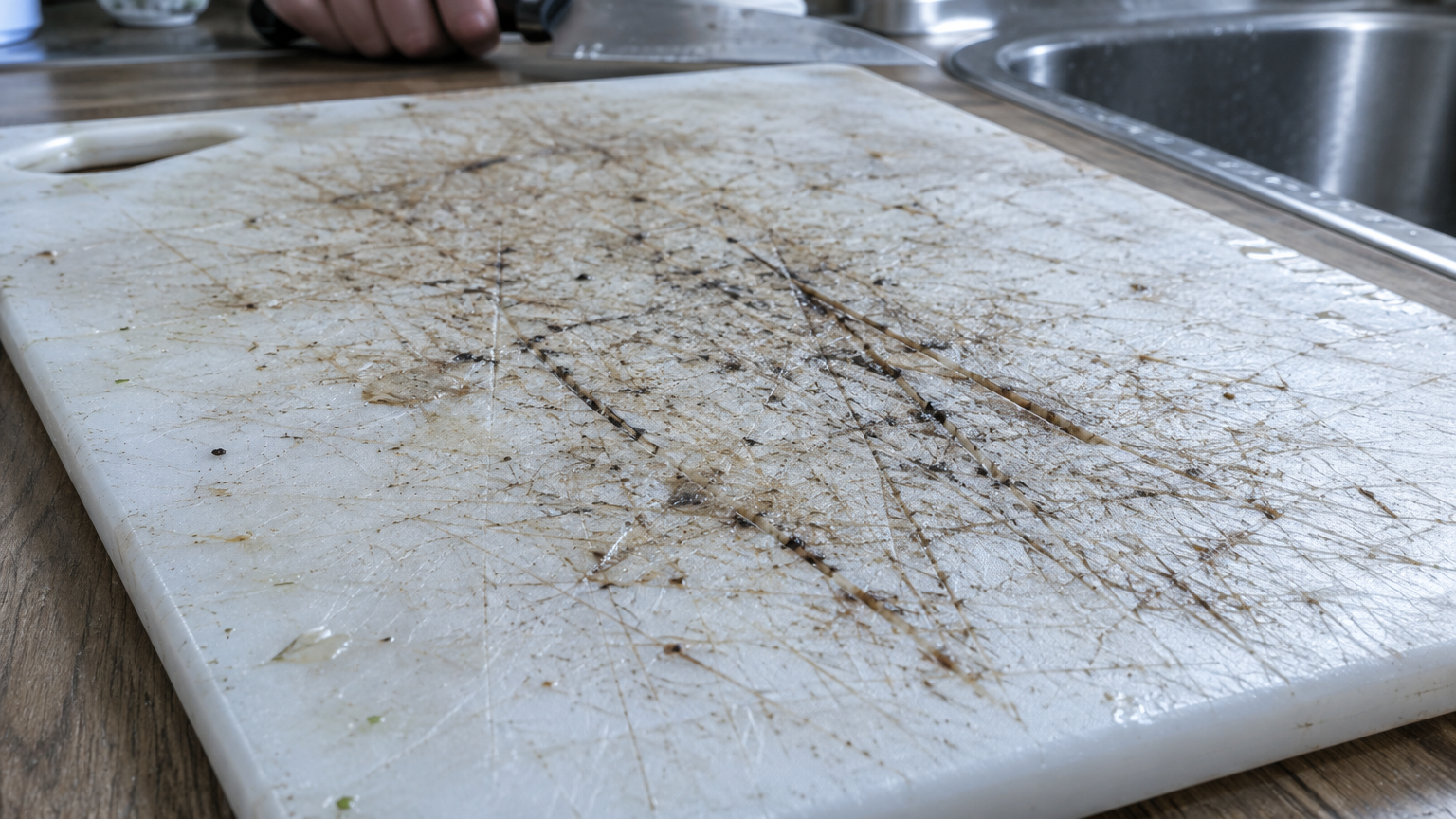
Plastic boards do not shed equally. Research on worn kitchen boards has found that measurable release of plastic fragments increases as a surface accumulates cuts and grooves, and that a new board releases considerably less than an old, deeply scarred one. The mechanism is mechanical: the blade breaks fibers, and those fibers have to go somewhere.
That nuance matters. The realistic concern is not the board you bought last month, it is the board you have been using for six years with a surface that looks like a topographical map. If your current board makes you wince when you look at it, you are the person this category was built for. If your board is a year old and mostly smooth, the microplastic argument is a smaller factor than you might think.
No study has measured the KensaiChef specifically. What follows is about the category, not a lab result on this product.
Cross-Contamination Is the Bigger, Better-Documented Risk
This is where the two-sided design earns its keep. The risk of transferring pathogens from raw poultry to ready-to-eat vegetables is well documented, and it does not depend on the material of your board. It depends on whether the two ever touch the same surface.
Classic food microbiology work on cutting boards found that bacteria inoculated onto plastic surfaces were readily recovered, while recovery from wood was generally lower, and that fluids containing bacteria were often absorbed completely within minutes. The takeaway is not that wood is magic. The takeaway is that surface material changes recovery characteristics, and no surface replaces washing.
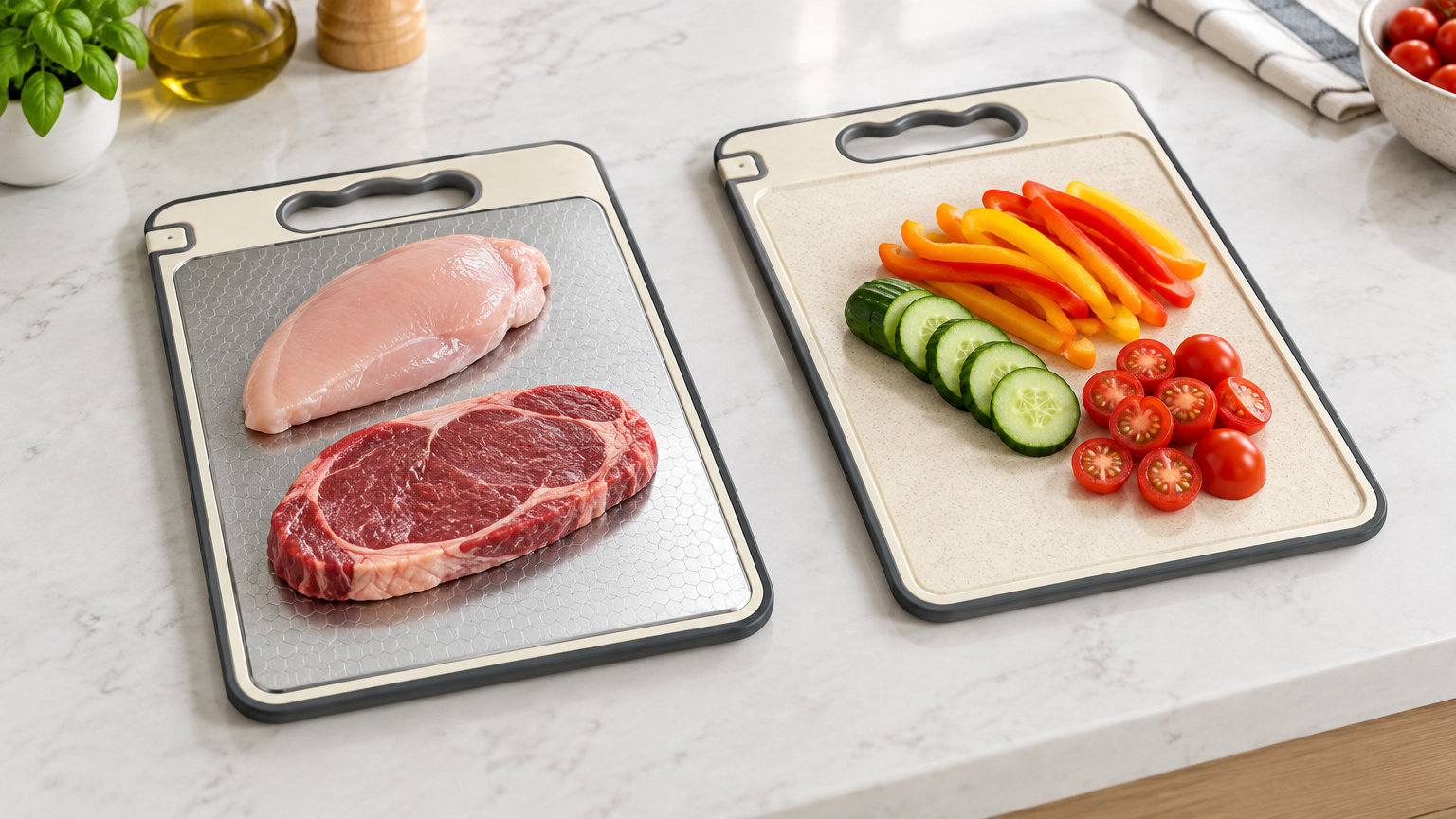
What the KensaiChef changes is structural, not chemical: it removes the excuse. Meat on titanium, produce on wheat straw, never the reverse. That is a genuine improvement over one board used for everything, and it does not require the brand's hygiene claims to be true for the benefit to exist.
What the KensaiChef Actually Is
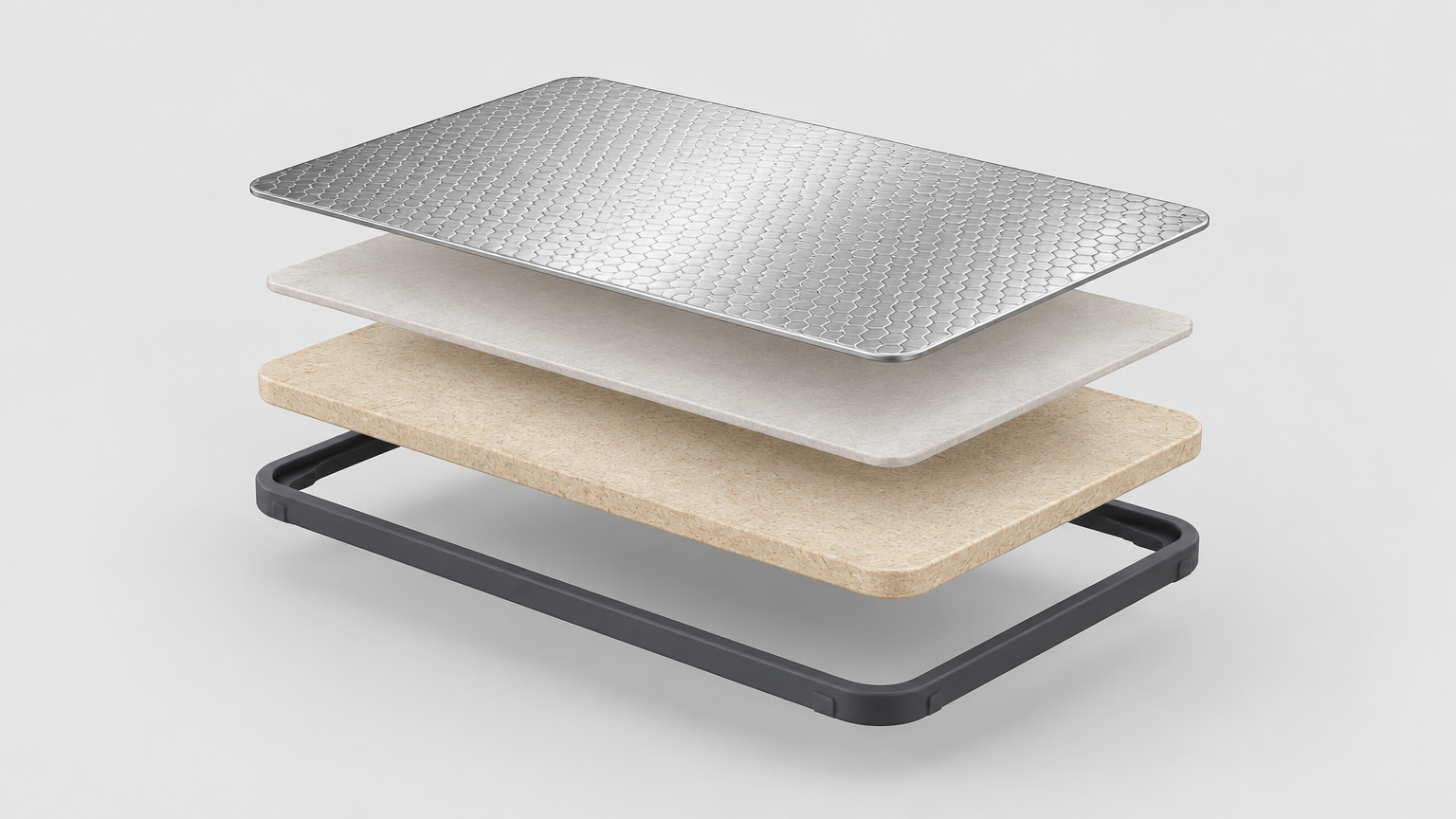
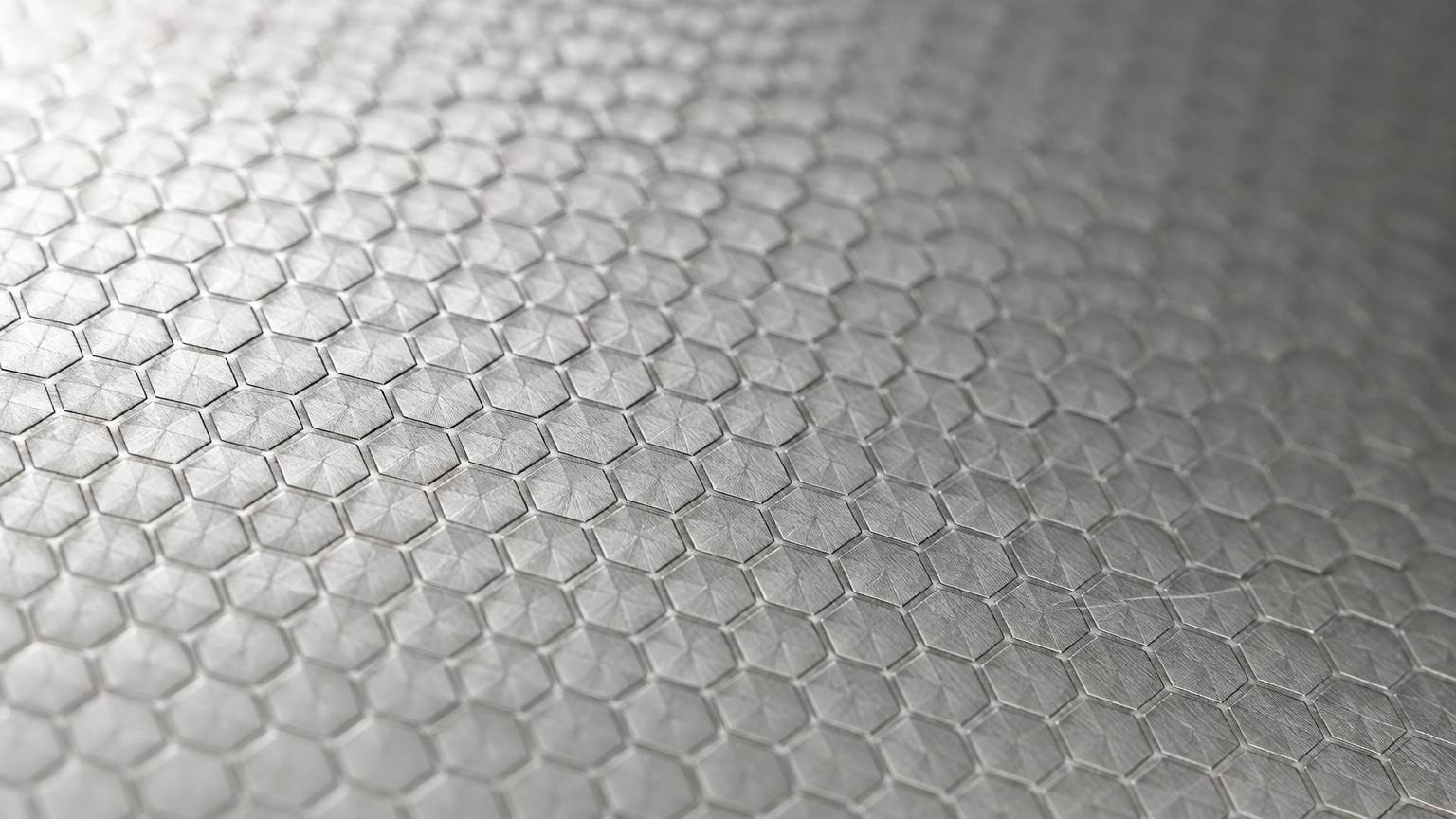
The board is roughly 12.2 by 8.3 inches and about 0.4 inches thick, according to the manufacturer. The titanium face has a laser-etched hexagonal pattern the brand calls HexCore. The opposite face is a cream-colored wheat straw fiber composite. A charcoal rubber rim runs the perimeter as a non-slip base, and there is a hanging cutout at one end.
Two specifications are missing, and it is worth saying so plainly: the brand does not publish the grade of titanium or the thickness of the titanium layer. That is a transparency gap, not a dealbreaker. It does mean you cannot verify whether the metal sheet is a solid plate or a thinner laminate over a core, and any review that claims otherwise is guessing.
The HexCore Surface
The hexagonal etching serves a practical purpose: it reduces the continuous flat contact area between the blade and the metal, which reduces suction and stiction and makes the board feel less slippery than a polished steel sheet. Whether it meaningfully changes friction is not something the brand has tested independently, and we could not verify it. Treat it as a design refinement, not a performance guarantee.
How the Two Sides Work in a Real Kitchen
Raw meat, poultry and fish go on the titanium. Rinse immediately after use, then wash with hot water and dish soap. Metal does not absorb, so a quick clean is genuinely sufficient in a way it is not on wood.
Vegetables, fruit, bread and cheese go on the wheat straw side. It is softer, quieter under the knife, and gives you the familiar give of a composite surface.
Never swap them mid-prep. The whole value proposition collapses the moment produce touches the meat side, even briefly.
Dry both faces standing upright. The rubber rim traps water against the counter if you lay it flat.
The Knife Question Nobody Answers Honestly
Here is the part the sales page omits. In July 2026, America's Test Kitchen tested metal cutting boards with a fresh knife on each board and measured sharpness with an industrial tester. Their finding was blunt: every time a knife was used on any of the metal boards, it dulled dramatically. There was no meaningful difference between titanium and stainless steel. The knife used on a wooden board stayed close to new.
Physics explains it. Titanium is harder than wood or plastic. A harder surface deforms a knife edge on contact instead of yielding to it. No surface treatment, texture or marketing angle changes that relationship, because it is a property of the two materials meeting.
What this means for you: the KensaiChef is a hard board and it will wear your edge faster than wood or plastic will. If you use one chef's knife for everything and you sharpen twice a year, you may not notice. If you keep a thin blade at a fine angle for precision work, you will notice within weeks.
The honest framing is that you are trading edge retention for two things metal does better. You are eliminating a plastic surface from your food prep, and you are guaranteeing physical separation between raw meat and produce. That trade is worth making for a lot of kitchens. It is not worth making if you did not know you were making it, which is why this section exists.

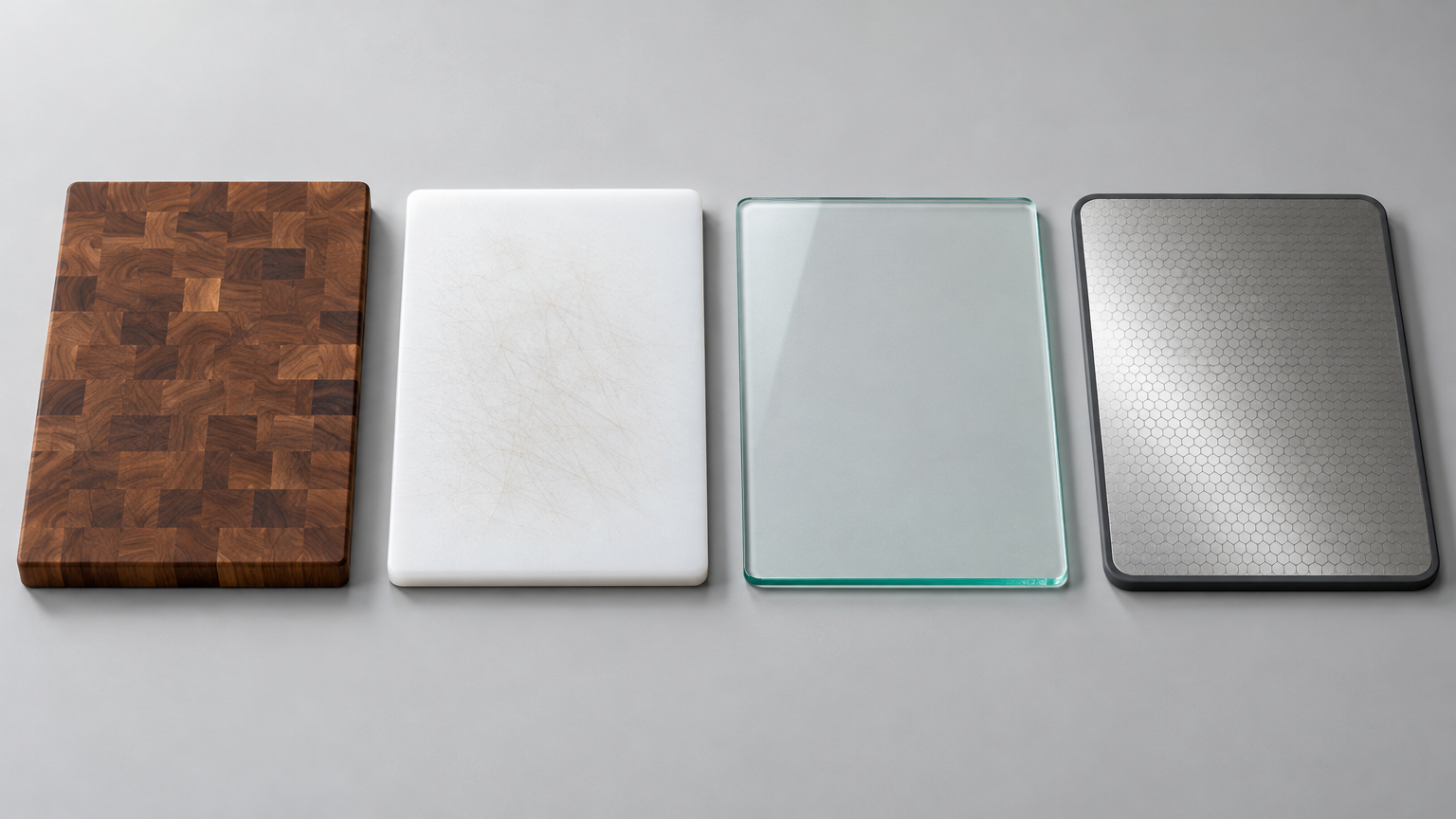
How It Compares to Wood, Plastic, Glass and Steel
| Material | Microplastic risk | Cross-contamination | Knife edge wear | Maintenance |
|---|---|---|---|---|
| Titanium (KensaiChef) | None from the metal face | Low, and separable by design | High | Low |
| End-grain wood | None | Lower recovery than plastic in studies | Low | High, needs oiling |
| Plastic | Increases as the board wears | Highest on scarred boards | Low | Low until it needs replacing |
| Tempered glass | None | Low | Very high | Low |
Wood wins on knives and loses on maintenance. Plastic wins on cost and loses as it ages. Glass wins on hygiene and loses badly on edge. Titanium wins on durability and surface hygiene and loses on edge. There is no overall winner, only a best fit for how you cook.
Price and What You Actually Pay
The checkout quotes a per-board price and a shipping fee, and the bundles scale down as you buy more:
| Bundle | Per board | Shipping | Real total | Per-board cost |
|---|---|---|---|---|
| 1 board | $59.99 | $7.75 | $67.74 | $67.74 |
| 2 boards | $49.99 | $7.75 | $107.73 | $53.87 |
| 3 boards | $45.95 | $7.75 | $145.60 | $48.53 |
| 4 boards | $35.90 | $8.75 | $152.35 | $38.09 |
Two notes the checkout does not volunteer. The crossed-out reference prices on the page do not reconcile with the per-unit math, so ignore the discount percentage and look at the per-board cost including shipping. And the comparison that matters is not the discount, it is the market: a functionally similar titanium and wheat fiber double-sided board from an established housewares brand sells around $34.90 on its own. The KensaiChef is not the cheap option. It is the direct-to-consumer option with a 30-day guarantee attached.
Payment and the 30-Day Guarantee
Checkout runs on credit card, with Visa, Mastercard, American Express, Discover, Diners Club, Elo, JCB and UnionPay shown, on an encrypted connection. A PayPal Verified seal appears in the security badge row at the bottom of the checkout, so PayPal is presented as part of the trust stack, though card is the payment method the page visibly offers as a selection. Confirm at checkout before you rely on it.
The guarantee is 30 days, money back, handled through the brand's support channel. Keep your packaging and your order email. A 30-day window is short for forming a view on a kitchen tool, so test it in the first week with the food you actually cook.
Who Should Buy It and Who Shouldn't
Buy it if you cook raw meat regularly and you are tired of sanitizing one board between stages. You want a board that will still look the same in five years. You have already decided plastic is out. Or you want a second board specifically so produce stops touching the meat surface.
Do not buy it if your knife collection is the point of your kitchen and you keep thin blades honed to a precise angle. If you cut with a rocking motion on a fine edge daily, this board is the wrong tool. And if you need one board that is quiet, forgiving and gentle, buy end-grain wood.
A note on the category, since it matters when you buy: the titanium board market has a documented problem with sellers advertising titanium and shipping stainless steel, with rough edges and unhelpful returns. If a listing is dramatically cheaper than everything else, that is usually why. When yours arrives, check that the metal face is genuinely non-magnetic and that all edges are smooth to the touch.
Frequently Asked Questions
Only one of the two faces is metal. The brand's own FAQ describes a titanium side for meat and fish and a wheat straw fiber side for produce, although the sales headline says "100% Pure Titanium." The brand does not publish the titanium grade or the thickness of the metal layer, so the composition of the plate cannot be independently verified.
Yes, faster than wood or plastic. America's Test Kitchen tested metal boards in July 2026 and found knives dulled dramatically on all of them, with no meaningful difference between titanium and steel. Titanium is simply harder than a knife edge, so contact deforms the edge instead of yielding to it.
Hand washing is the safer routine. The metal face rinses clean in seconds, and the wheat straw composite and rubber rim will last longer away from sustained high heat. Wash with hot water and dish soap, then stand it upright to dry so water does not sit trapped under the rim.
Yes, that is the titanium side's main job. Metal does not absorb juices, so it cleans more thoroughly than a scarred plastic board. Wash it with hot water and soap immediately after raw meat, and keep produce on the opposite face so the two never share a surface.
Roughly 12.2 by 8.3 inches and about 0.4 inches thick, according to the manufacturer. That is a medium board, comfortable for a chicken breast or a pile of vegetables, and small for carving a large roast. It fits most sink basins for washing.
A single board is $59.99 plus $7.75 shipping, for a real total of $67.74. The four-pack drops to $35.90 per board plus $8.75 shipping, or $152.35 total. Ignore the crossed-out reference prices on the page and compare the per-board cost including shipping instead.
The brand offers a 30-day money-back guarantee handled through its customer support channel. Keep your order confirmation and the original packaging, and test the board within the first week so you have time to decide. The window is short for a kitchen tool.
Check the metal face with a magnet when it arrives. Stainless steel used in kitchen boards is typically magnetic, while titanium is not. Also run a finger along every edge: a legitimate board should have smooth, finished edges. If either check fails, use the 30-day guarantee immediately.
Verdict
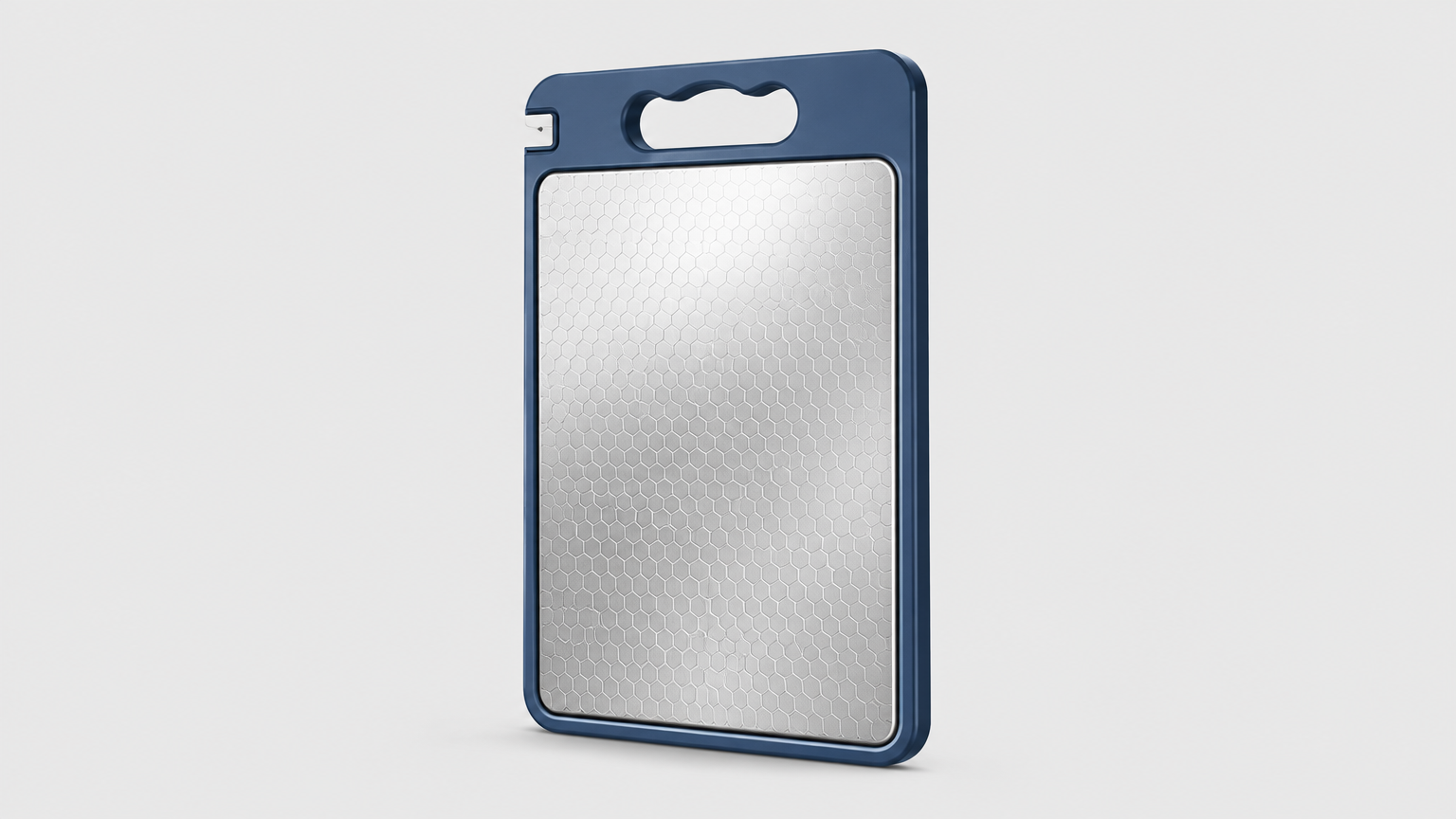
The KensaiChef solves a real problem competently and then asks you to accept a cost it does not advertise. The two-sided design genuinely separates raw meat from produce in a way one board cannot, the metal face will not harbor the scratches and residue that make old plastic boards unpleasant, and the thing will outlast almost anything else in your drawer.
The cost is your knife edge. Metal is harder than steel at the edge, and no texture pattern changes that. If your knives are workhorses and you sharpen a few times a year, this is a fair trade for a cleaner kitchen. If your knives are the reason you enjoy cooking, buy end-grain wood instead and accept the maintenance.
Our recommendation: worth it at the four-board price for a household that cooks meat regularly and wants to eliminate a plastic surface. Not worth it as a primary board for someone with fine knives. Editor's rating reflects our assessment of value and design, not laboratory measurement.