Ultra Air Heater Review: What 500W Really Costs to Run in Canada
At Ontario's off-peak rate it is about 4.5 cents an hour — roughly $11 a month. What it won't do is heat a room, and that distinction decides whether it is worth it for you.
By Marcus Doyle · Senior Editor, Home & Energy · Updated October 29, 2026 · 11 min read
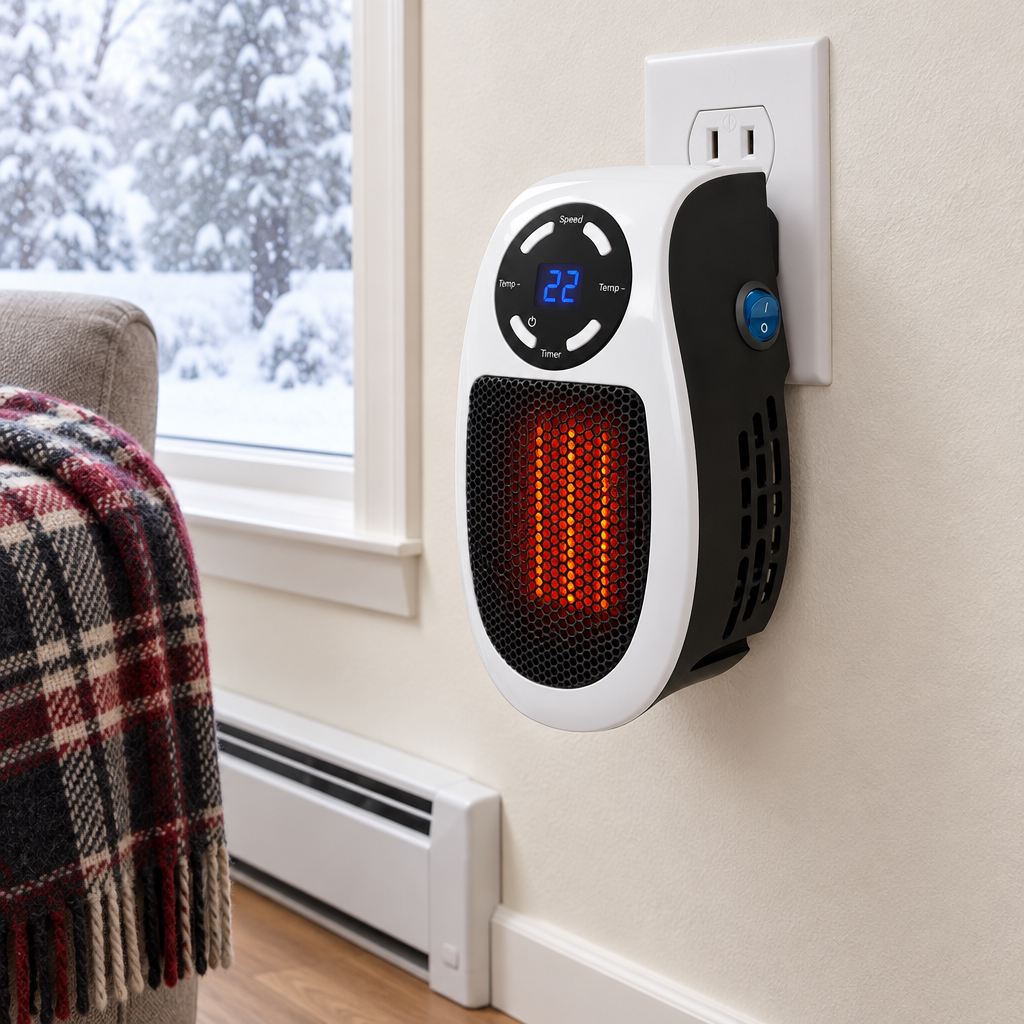
Plugged straight into the wall outlet and running — no cord, no extension cord.
From US$44.10 · 60-day money-back promise (per seller) · see the currency note below
This is a real heater with a real ceramic PTC element and real safety features, and it is genuinely cheap to run — about 4.5 cents an hour at Ontario's off-peak winter rate (OEB). What it is not: a room heater. At 500W and roughly the size of your hand, it warms the spot you point it at.
One Canadian-specific caveat that matters: pricing is in US dollars at checkout and the seller ships from the US, so confirm the landed cost before you order.
A note for Quebec readers specifically: your baseboard heating is already among the cheapest in the world, so the savings argument is far weaker than it is in Nova Scotia or Nunavut.
If you searched for an Ultra Air Heater review for Canada, the questions are practical: is it legitimate, what does it cost on a Canadian hydro bill, and what should you pay for it? This page answers those with the rates published by Canadian regulators and the checkout as it is shown today.
Quick facts
Product
Portable plug-in space heater, 500W PTC ceramic
Size
About 10 × 16 × 9 cm, roughly palm-sized
Setup
Plugs directly into a wall outlet, no cord
Cost to run
About $0.045 per hour at Ontario off-peak (9.1¢/kWh, OEB)
Claimed coverage
Up to 250 sq ft (vendor claim, not independently tested)
Safety
Overheat and tip-over protection, per the manufacturer
Prices
US$44.10 / US$88.20 / US$105.84 for 1 / 2 / 3 units
Currency
US dollars at checkout — see the note in the pricing section
Guarantee
60-day money-back, per the seller
Support
support@langleyretail.com
The real cost per hour in Canada
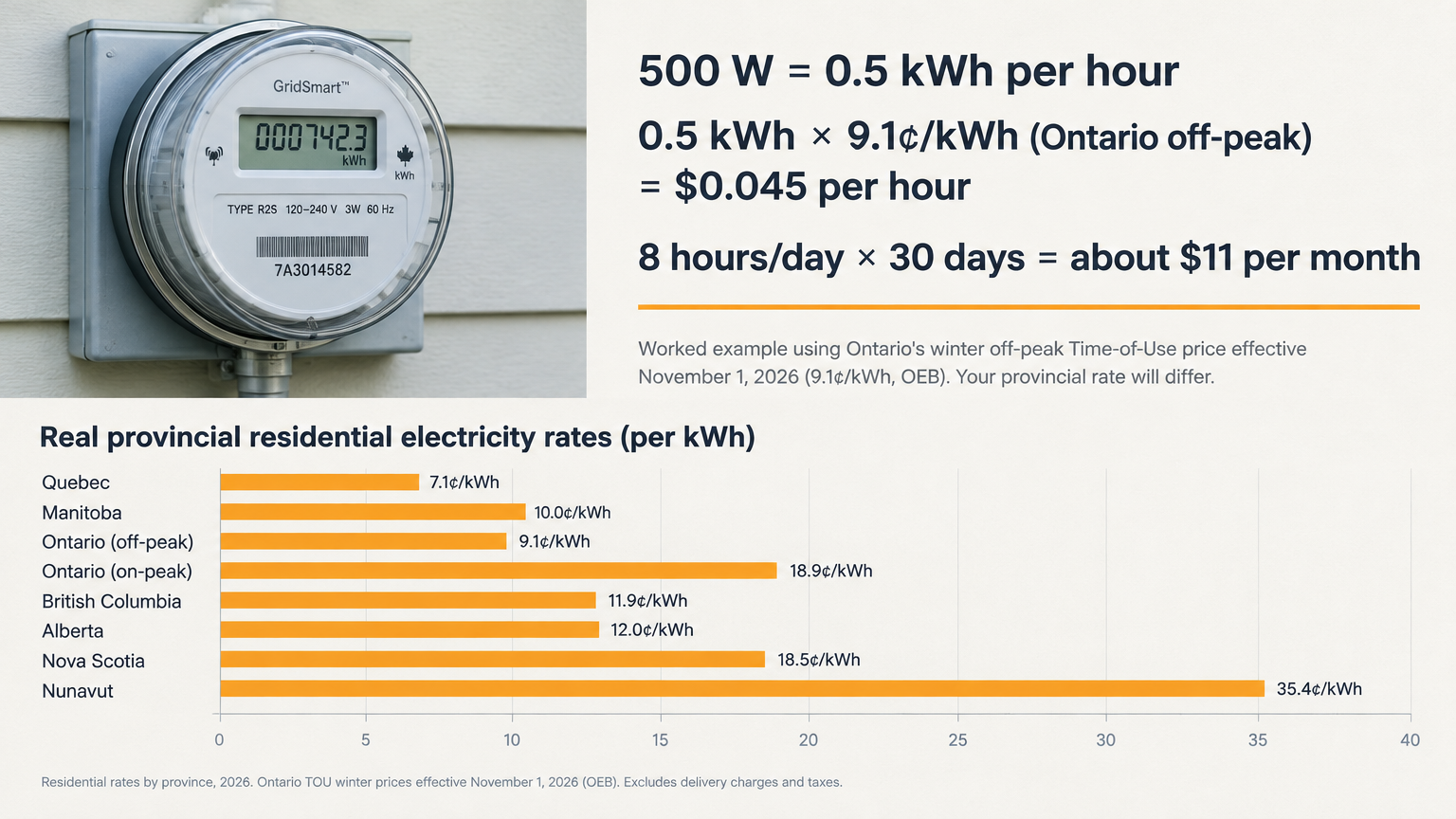
Electricity is billed per kilowatt-hour (kWh). A 500W heater uses half a kWh every hour it runs.
The formula is short: 500W = 0.5 kWh per hour. At Ontario's off-peak winter rate for 2026–27 of 9.1¢/kWh (OEB), that is 0.5 × 9.1 = 4.55¢ per hour, or about $0.05 rounded. Eight hours a day for 30 days comes to roughly $11 a month.
The same use during Ontario's on-peak period (18.9¢/kWh) costs about 9.45¢ an hour and roughly $23 a month.
Scale at 9.1¢/kWh (Ontario off-peak), 8 hours a day for 30 days
Heater power
Per hour
Per month
500W
$0.045
$11
750W
$0.068
$16
1000W
$0.091
$22
1500W
$0.137
$33
2000W
$0.182
$44
At the national average of about 15¢/kWh, the same 500W heater costs about $0.075 an hour, or roughly $18 a month at 8 hours a day.
The same 500W heater costs $11 a month in Ontario off-peak — and up to $28 in Nunavut. Your province, not the device, sets the number.
A note on honesty: low cost per hour is not the same as efficiency. One kWh of electric heat costs one kWh of electricity. A 500W heater is cheap to run because it delivers a quarter of the heat of a 2000W unit.
Provincial electricity rates (2026)
Quebec about 7.1¢/kWh · Manitoba 9.97¢ · British Columbia 11.87¢ (first 675 kWh/month, Step 1) and 14.08¢ (Step 2) · Ontario 9.1¢ off-peak, 14.6¢ mid-peak, 18.9¢ on-peak · Alberta about 12¢ · Nova Scotia about 17–20¢ · Nunavut 35.4¢.
The same device varies by up to four times depending on where you live.
Ontario time-of-use, explained (and the rebate change most people missed)
Since 1 November 2026, Ontario's time-of-use (TOU) pricing for winter 2026–27 has three periods: off-peak at 9.1¢/kWh (weekdays 7pm–7am, and all day on weekends and holidays), mid-peak at 14.6¢/kWh (weekdays 11am–5pm), and on-peak at 18.9¢/kWh (weekdays 7–11am and 5–7pm). Households that opt into Ultra-Low Overnight (ULO) pay 3.7¢/kWh from 11pm to 7am every day, with on-peak ULO at 37.7¢/kWh on weekdays from 4 to 9pm.
Here is what almost no review mentions: on 1 November 2026 the Ontario Electricity Rebate dropped from 23.5% to 15.7%. The commodity prices went down, but the rebate went down by more, so many households will not see their bill fall — and some will see it rise. Plan your heater usage against the delivered cost on your own bill, not against the headline rate.
Practical tip: on a ULO plan, running the heater overnight (11pm–7am) costs about 40% of the normal off-peak rate and under a fifth of on-peak. For someone working from home during the day, TOU is the worst setup for a heater, and tiered pricing may be better. For bedroom use at night, TOU and ULO are the best case.
Why 500W can't heat a room
500W is roughly what a couple of incandescent bulbs or a hair dryer on low draws. A typical Canadian room in winter, with exterior walls and windows exposed to −20°C air for much of the country, loses heat far faster than that can replace it.
The vendor's claims of "250 sq ft" and "any room to 75 degrees in less than 2 minutes" describe the reach of the airflow, not the capacity to heat the mass of air in a room. This is a heater for a place, not a space: a desk, a chair, a counter or a cold corner.
It heats one spot, not the whole house. That's the entire point — and the entire limitation.
One real-world nuance: some buyers report the PTC thermostat modulating power to about 425W, which lowers both cost and heat output in roughly the same proportion. We did not measure this ourselves.
What it actually is
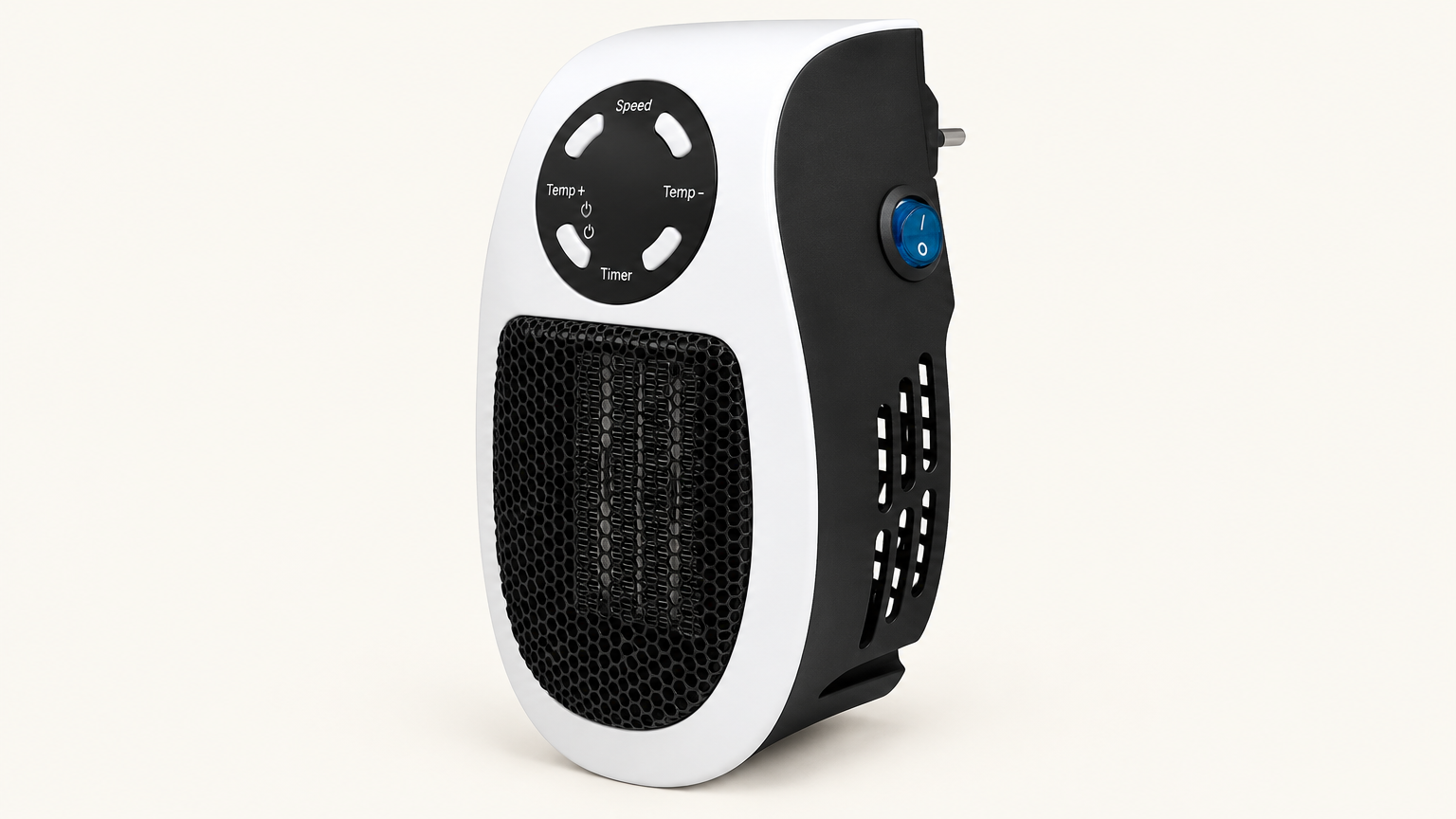
The Ultra Air Heater is a compact plug-in unit with a white body, a black honeycomb front grille, a four-button control panel (Speed, Temp +, Temp −, Timer), a central display, a blue side switch and an integrated NEMA 5-15 plug. Per the manufacturer, it uses a 500W PTC ceramic element. PTC ceramic is a legitimate, self-regulating heating technology; what needs calibration is the coverage the seller claims, not the element itself.
Compact white body, black honeycomb grille, four-button control panel and integrated plug — the hardware, nothing added.
Safety
Overheat protection
Per the manufacturer, it reduces output from 50°C to 40°C and shuts off if it exceeds 50°C three times in a row.
Tip-over protection
If it falls, it stops, blows ambient air for 30 seconds and cuts power.
Direct plug-in
Plugs straight into the wall. Never use an extension cord or power bar.
Built-in thermostat
Holds the set temperature and modulates output, per the seller.
Manufacturer instructions to follow
Plug it directly into a wall outlet and never into an extension cord or power bar. Never leave it running unattended. The surface gets hot. Do not use it in bathrooms or damp areas unless it is rated for them. Keep it away from children and pets, and keep about 3 feet (90 cm) clear of furniture, curtains and walls.
These instructions appear in the manufacturer's own documentation. With a heater, they matter more than any marketing claim. In Canadian homes with baseboard heaters along the walls and heavy winter curtains near outlets, that 90 cm clearance needs real attention, not a glance.
Legit or scam? An honest answer
The product is real and the mechanism is real: it is a 500W PTC ceramic heater with the safety features the seller describes. The store is new, and the headline claims — "up to 30% off your energy bill" and "heats any room to 75 degrees in less than 2 minutes" — come from the seller and have no published data behind them. We attribute them to the seller and do not repeat them as fact.
There is mixed reporting. ExpertPicked rates it 3.8/5, confirms the 500W PTC element and the overheat and tip-over protection, and describes it as localized heating. MalwareTips reports refunds that it says were ignored and units that were underpowered. Sites that aggregate customer reviews show generally positive results. We cannot verify any of these in one direction.
Concretely: (a) we found no independent or institutional test of this heater; (b) the same type of heater is sold generically on marketplaces — Walmart lists variants from about $16 with a 4.2/5 rating, and at least one reviewer reports receiving a European plug; (c) buying through the official checkout gives you access to the 60-day promise and to support. We did not test the unit ourselves.
Prices and the currency question
Prices are shown in US dollars at checkout. The same checkout serves US customers.
Single unitwas $98.00US$44.1050% + 10% off, per the seller
Two unitswas $196.00US$88.20Two heaters, one order
Best value · most popularwas $294.00US$105.8460% + 10% off, per the seller
Read this before you order from Canada
The checkout is the same one used for US customers and shows prices in US dollars. It also advertises US-based shipping. That means your card issuer will apply its own exchange rate, and your order may attract customs handling fees, duty or provincial and federal taxes on import depending on how it is declared and shipped.
We are not able to state a final CAD price because it depends on your card and your province. Confirm the total landed cost before you pay — and if a clear CAD price and Canadian shipping are not shown, treat that as a reason to pause.
Our suggestion: to test the product, one unit is enough. The device is identical across the three packs, so a multi-pack only makes sense if you already know you want more than one.
The seller's wording: "Try Risk-Free: 60 Day Money-Back Promise" and "Give it a go for 60 days, and if you're not seeing the difference, we'll refund every penny." Per the seller, that is the guarantee.
Sixty days is a fair window, but for a Canadian buyer, an international return can cost more than the product itself. Before you buy, confirm in writing the return address and who pays return shipping, and keep your order confirmation and the guarantee text.
Very low cost per hour: about 4.5¢ in Ontario off-peak, about 3.5¢ on ULO.
No installation; it plugs straight into a wall outlet.
Overheat and tip-over protection, per the manufacturer.
Small and discreet, with a built-in thermostat and timer.
Useful where a baseboard does not reach, such as a desk or a cold bathroom corner (where rated).
Cons
It does not heat a room; 500W is personal, localized heat.
The "30% savings" and "2 minute" claims have no published test behind them.
No independent test exists.
Priced in USD and shipped from the US, with possible currency conversion and import fees.
Much cheaper generic versions exist on marketplaces — check the plug and the seller.
New store with divergent refund reports.
In Quebec the savings argument is weak, because electricity is already very cheap.
How to buy safely from Canada
Buy only through the official checkout.
Confirm the plug is NEMA 5-15, the Canadian standard. Do not accept a European plug.
Check the final CAD cost, including currency conversion and any possible import fees, before you pay.
Pay with a credit card, not a debit card.
Keep the order confirmation and the guarantee text.
Plug it directly into a wall outlet — never a power bar or extension cord — and keep 90 cm of clearance.
Frequently asked questions
What is the Ultra Air Heater?
A portable 500W plug-in ceramic space heater with a PTC element and a palm-sized body that plugs directly into a wall outlet, according to the seller.
How much does it cost to run in Canada?
At Ontario's off-peak winter rate of 9.1¢/kWh (OEB), about 4.55¢ per hour. Eight hours a day for 30 days is about $11 a month.
Is it cheaper to run in Quebec than in Ontario?
Yes, per hour. Quebec's residential rate of about 7.1¢/kWh is among the lowest in the country, but baseboard electric heat there is already cheap, so the savings are smaller.
Can it heat a bedroom in a Canadian winter?
Not in any meaningful way. At 500W it provides personal, localized warmth. The seller's room-coverage claims have not been independently tested.
Will it lower my hydro bill?
Not necessarily. Running a heater adds consumption, and since 1 November 2026 the reduced Ontario Electricity Rebate may leave some bills unchanged or higher.
Why is the price in US dollars?
The checkout is shared with US customers and displays USD. Your card issuer converts the amount to CAD at its own rate.
Will I pay duty or customs fees in Canada?
Possibly. Depending on how the order is declared and shipped, customs handling fees, duties or taxes may apply. Confirm the landed cost before paying.
Is the Ultra Air Heater safe?
The manufacturer describes overheat and tip-over protection and says it must be plugged directly into a wall outlet, never an extension cord or power bar.
Has it been independently tested?
No. We found no independent or institutional test of this product. This review uses published specifications, safety instructions, checkout pricing and provincial tariffs.
How does the 60-day guarantee work from Canada?
The seller advertises a 60-day money-back promise. Confirm in writing the return address and who pays return shipping before you buy.
Verdict
The Ultra Air Heater is a real, inexpensive-to-run personal heater with real protections. It does not heat a room and it does not replace your home's heating. For a desk, a chair, a counter or a cold corner, the math works. For a bedroom in a Canadian winter, it does not.
The right decision is the one that matches your space — and your province, not the biggest discount.
Overheat + tip-overProtection, per the manufacturer
60-day money-backPer the seller
MD
Marcus Doyle · Senior Editor, Home & Energy, Gadget Gear Reviews
Marcus covers household energy costs. This is a documentary review based on the seller's official pages, the published specifications and safety instructions, the USD checkout price, and tariffs published by the Ontario Energy Board, Hydro-Québec, BC Hydro and other provincial regulators. No practical test was performed, and no institutional test of this product exists. All cost figures are worked examples using published rates and will differ from your own bill.