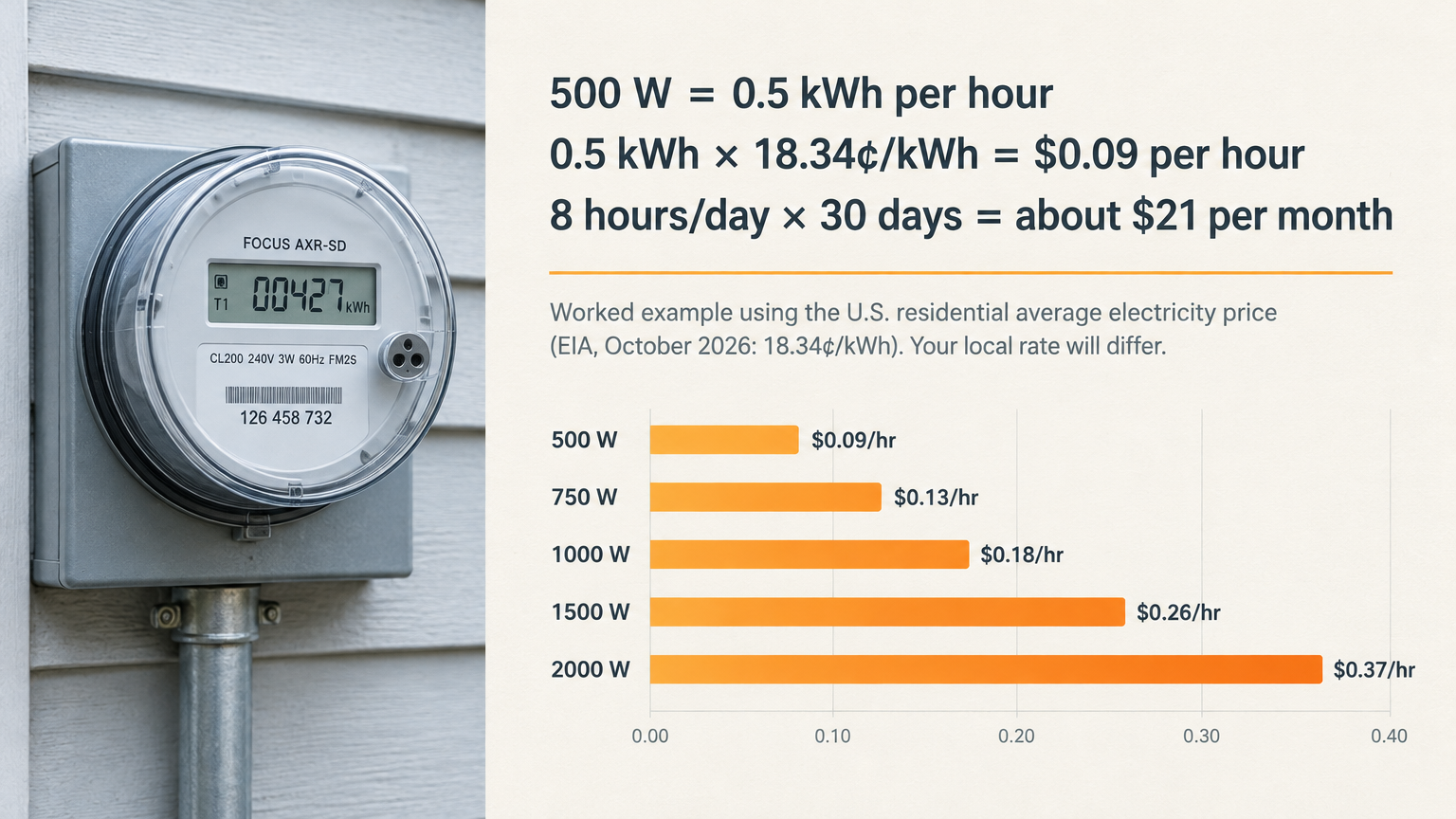
Enter the wattage, how long you run it, and your electricity rate. You'll see the cost per hour, per day, per month and for the whole heating season — using the formula your utility actually bills you with.
See current heater prices → From $44.10 · 60-day money-back promise (per seller)Defaults assume a 1500 W heater, 8 hours a day, 150 days, at the U.S. average rate. Change any value.
Printed on the label or in the manual. Most plug-in units run 500–1500 W on high.
Default: U.S. residential average, October 2026 (EIA). Your rate is printed on your bill.
How long the heater runs on a typical day. Default assumes 8 hours.
Number of days you expect to use the heater this year.
Calculated at the current rate: 18.34 ¢/kWh (EIA U.S. average, October 2026).
| Wattage | 1 hr | 2 hr | 4 hr | 8 hr | 12 hr | Per month (8h/day) |
|---|
Once the running cost fits your budget, compare heaters by wattage, safety features and return policy.
Compare plug-in heater prices →
The physics is simpler than the marketing.
In direct electric resistance heating, every kilowatt-hour of heat costs one kilowatt-hour of electricity. That is true whatever the appliance, its price or its brand. There is no magic efficiency: a resistance element is a resistance element. Ceramic, oil-filled, fan-forced or infrared, the electricity in becomes heat out, almost one for one.
That means the running cost is set by just two numbers: wattage and time. A 1500 W heater is not "better" than a 500 W one. It delivers roughly three times the heat and draws three times the power, so it costs three times as much per hour at the same rate.
The useful question is not which heater is the most efficient, because most are nearly equal on that front. The useful question is how much power you actually need for the area you want to warm.
Four checks before you trust any calculator, including this one.
Monthly cost of a 1500 W heater, 8 hours a day, 30 days.
Electricity prices differ widely across the country. The U.S. Energy Information Administration publishes state residential averages, and they range from about 13 cents per kWh in Nevada to about 53 cents in Hawaii. The same heater, run the same way, costs up to four times as much in one state as in the other.
| State | Rate (¢/kWh) | Monthly cost |
|---|---|---|
| Nevada | 13.11 | ~$47 |
| Texas | ~15.0 (approx.) | ~$54 |
| National average | 18.34 | ~$66 |
| New York | ~24 (approx.) | ~$86 |
| California | ~31 (approx.) | ~$112 |
| Hawaii | 52.72 | ~$190 |
State figures other than Nevada, Hawaii and the national average are approximate regional averages and vary by utility and plan. Always use your own bill.
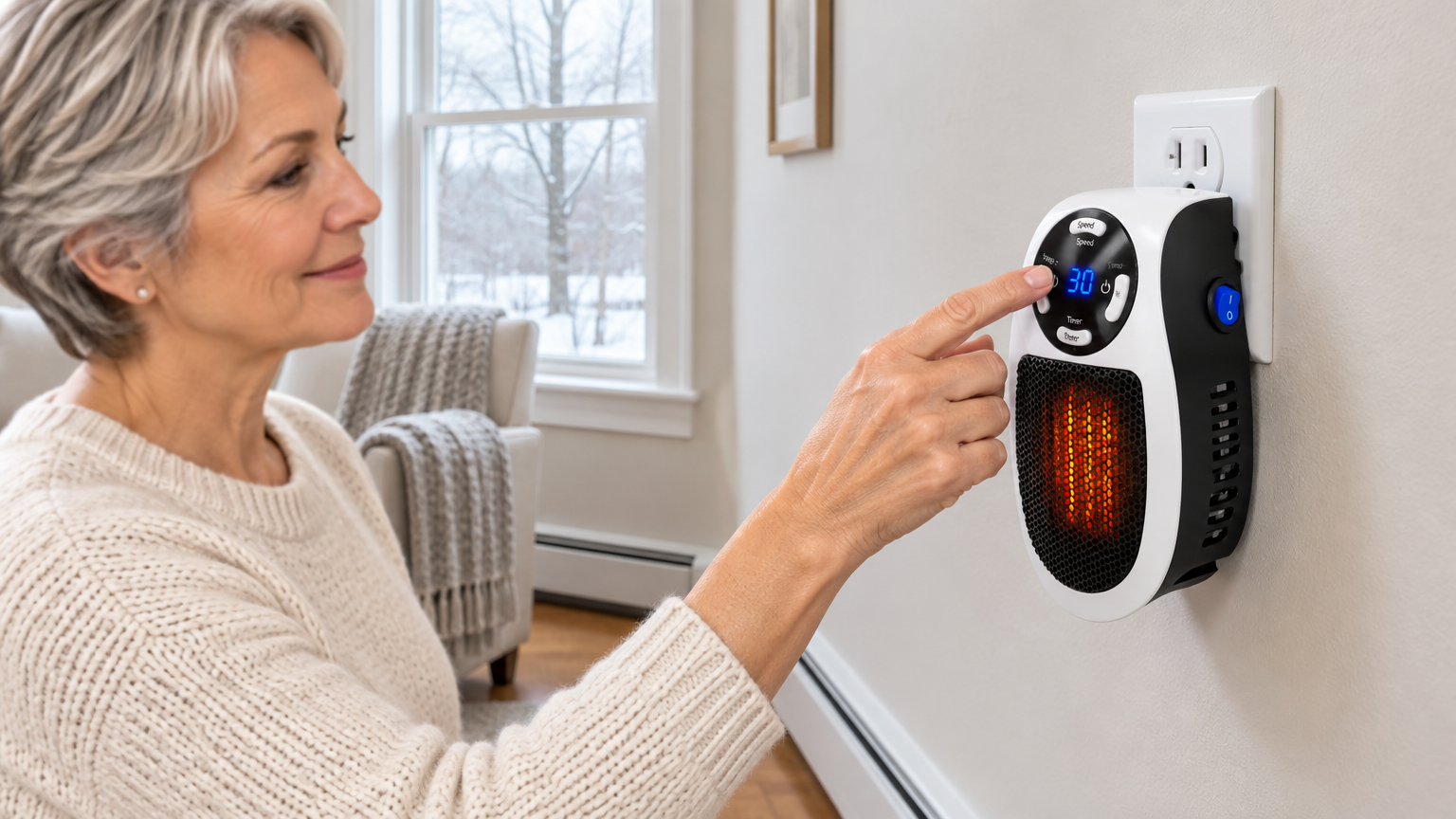
Match the output to the space, not to the highest number on the box.
| Wattage | What it realistically heats | Typical use |
|---|---|---|
| 400–500 W | A spot: a desk, a chair, a workbench | Home office, garage bench, RV, one cold corner |
| 750–1000 W | A very small room, closed door | Small bedroom, bathroom (if rated for it), cubicle |
| 1500 W | A small-to-medium room | Bedroom, living room in mild climates |
| 2000–2500 W | A medium room, but check your circuit | Larger rooms; requires a dedicated 20 A circuit, not a shared one |
The electrical limit can matter more than the price per hour.
Short answers with the numbers behind them. Rates from the U.S. Energy Information Administration (EIA).
Divide the wattage by 1,000, multiply by the hours you run it, then multiply by your rate in dollars per kWh. A 1500 W heater run 8 hours at the U.S. average of 18.34 ¢/kWh costs about $2.20 a day.
Most plug-in space heaters draw between 500 W and 1500 W on high, and some larger units reach 2000 W or more. The figure is printed on the label or in the manual.
It depends on the room and the hours. A space heater warms only the space you use, so heating one room for a few hours can cost less than a whole-house system. Heating a large area for many hours usually costs more.
At the U.S. residential average of 18.34 ¢/kWh (EIA, October 2026), a 1500 W heater run 8 hours a day for 30 days costs about $66 a month. A 500 W heater on the same schedule costs about $22.
Yes. Cost scales directly with wattage. A 1500 W heater uses three times the electricity of a 500 W heater for the same time.
Per hour they cost less than many people expect, but the total adds up over a season. Rates vary by state, so the same heater can cost up to four times more in Hawaii than in Nevada.
Use the rate printed on your bill, in cents per kWh. The U.S. residential average was 18.34 ¢/kWh in October 2026, according to the EIA.
A 1500 W heater uses 1.5 kWh per hour at full power.
Only if the unit is rated for unattended operation and has tip-over and overheat protection. The U.S. Consumer Product Safety Commission recommends turning heaters off when you leave the room or go to sleep.
The calculator uses the supply rate only. Delivery charges, taxes and fixed fees add to the bill, so your actual cost per kWh is often a few cents higher.
Pick the wattage that matches your room, then check current prices and return terms.
See current heater prices →